

Onto real hardware
Your program runs in the emulator. Here are the four ways to get it onto an ACE, in the order most people reach for them.
| Way | You need | Good for |
|---|---|---|
| Memory card | A CompactFlash card and a reader | Everything, most of the time |
| Serial cable | A USB-to-serial adapter | Iterating without moving a card |
| Wozmon paste | Just the cable | Small machine-code experiments |
| EEPROM | A TL866-family programmer | Cartridges |
The memory card
Build an image with cffs, write it to the card, put the card in the ACE.
cffs create disk.img --size 1M
cffs add disk.img COUNT.PRG
cffs list disk.img
Created disk.img (1,048,576 bytes, 2,048 sectors, 1 disk)
Added COUNT.PRG to disk 0 of disk.img
Disk 0
Name Size Start Sectors
──────────── ─────── ───── ───────
COUNT.PRG 49 1 1The card's directory holds eight characters plus a three-character extension, and a longer name is refused rather than quietly shortened:
Error: Invalid filename: name part must be 1-8 characters, got "COUNTDOWN"--name renames a file on the way in, so your source tree can call things whatever you like:
cffs add disk.img build/countdown.prg --name COUNT.PRGTry the image before you write it to anything:
6502 run --cf disk.imgDIR
DISK 0
COUNT .PRG 49
LOAD "COUNT.PRG"
RUNThen write disk.img to the card with whatever your operating system uses for disk images (dd, Raspberry Pi Imager, balenaEtcher — it is a raw image, not a filesystem your computer knows). Card in the ACE, and DIR shows the same listing.
A card holds up to 256 of these one-megabyte disks; --disks 32 builds a bigger image, --disk 3 puts a file on a particular one, and DISK 3 on the machine selects it. Storage covers the model from the machine's side.
Keep the image in the build, not in the repository
make cf rebuilds the image from the current program every time. A disk image checked into version control is a 1 MB binary that goes stale immediately.
Over the serial cable
With a terminal already connected — Serial and a terminal sets that up — you can push a program down the wire without touching the card.
On the ACE:
LOAD
XMODEM RX READY
Then start an XModem send in your terminal program and pick your .prg. The machine takes it, and RUN runs it.
Going the other way, SAVE with no filename gives you XMODEM TX READY and you start an XModem receive. That is how you get a listing you wrote at the machine back onto your computer.
You have about a minute to start the transfer before the ACE gives up and returns to the prompt — harmless, just type the command again.
This is the fastest loop for hardware work: edit on your computer, make, send, run, repeat, with the card never leaving the slot.
BLOAD with an address and no name takes raw bytes the same way — a block of level data, or machine code built for somewhere other than $0800. The transfer rounds the file up to a 128-byte block, so leave room after it.
The Wozmon paste
The crudest path, and the one that needs the least. bin2woz turns your binary into deposit lines:
bin2woz -a 0x0800 build/countdown.prg > countdown.woz0800: 0A 08 0A 00 A5 32 30 36 30 00 00 00 A9 0A 85 40
0810: A5 40 A2 00 20 96 A0 20 93 A0 C6 40 D0 F2 A9 26
0820: A0 08 20 90 A0 60 4C 49 46 54 20 4F 46 46 0D 0A
0830: 00Get to Wozmon with SYS 65280 at BASIC's prompt; its prompt is a backslash. Paste the text into your terminal and the bytes go into memory a line at a time. No protocol, no card, nothing to install on the ACE's side.
C000R takes you back to BASIC, and SYS 2060 starts the program at $080C, just past its BASIC stub:
SYS 2060
10
9
8
7
6
5
4
3
2
1
LIFT OFF

OK
Don't paste a program you then want to RUN
Wozmon deposits bytes one at a time and has no idea how many arrived. BASIC needs that count: it puts its variables immediately after the program image, and without a length it walks the tokenized line chain instead — which ends at $080C, right on top of your machine code. The first variable your program sets overwrites itself.
LOAD hands BASIC the byte count properly. Use Wozmon for code you'll start with SYS, not for programs you intend to RUN.
Burning a cartridge
A cartridge is a 32 KB image for an AT28C256 EEPROM, and make in the 6502-CRT template produces one:
cl65 -t none -C 6502.cfg -l Cart.lst -o Cart.crt Cart.asmTry it first — this costs nothing and catches everything except a bad chip:
6502 run --cart Cart.crtThen burn it:
minipro -p AT28C256 -w Cart.crtChip into the cartridge board, cartridge into the ACE, power on. The cartridge supplies the reset vector, so it boots straight into your program with no header and no BASIC.
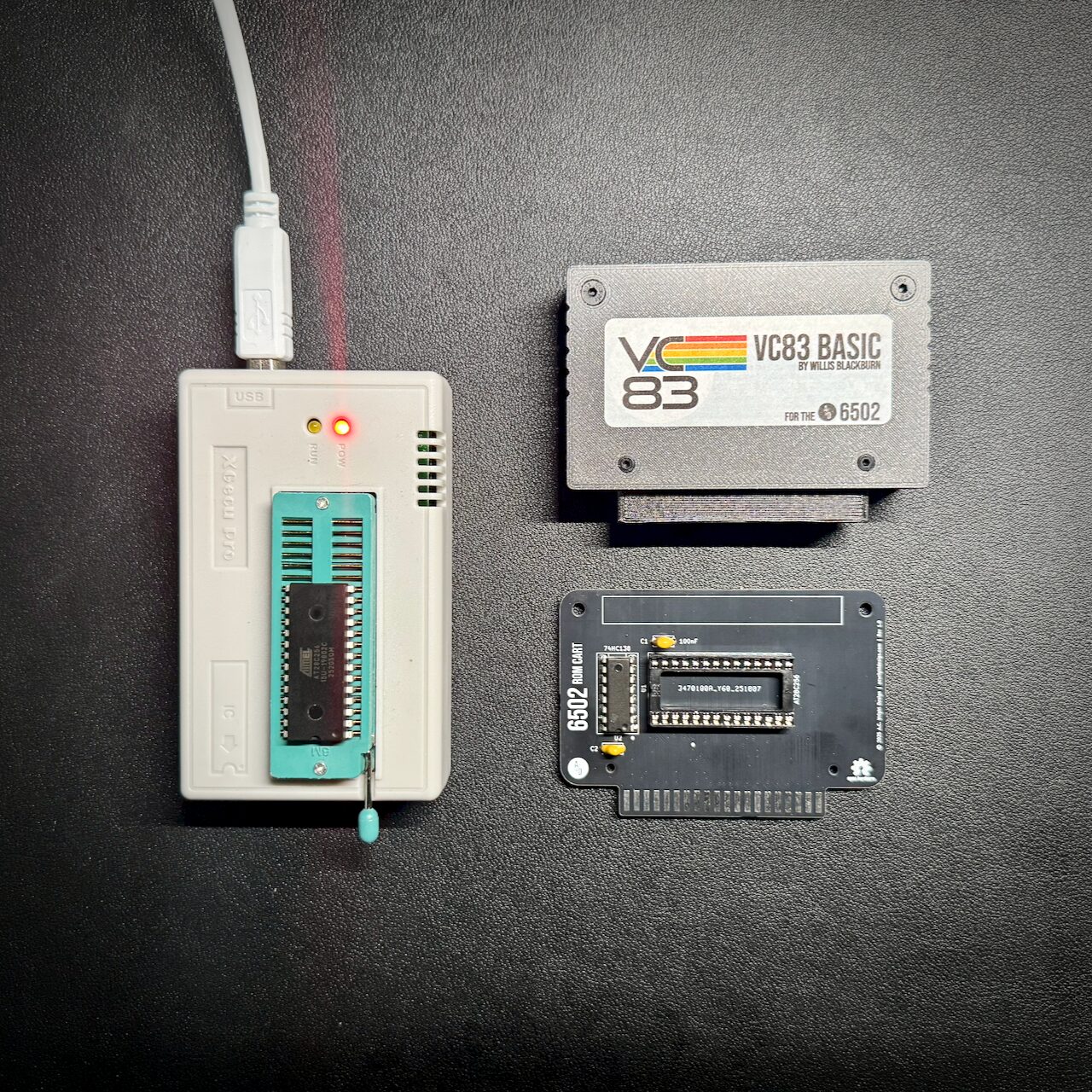
Why the image is 32 KB when the cartridge is 16 KB
The chip is 32 KB and the machine only reads its top half — the cartridge appears at $C000–$FFFF. The build pads the unused lower half with zeroes so the file matches the chip, which is what the programmer expects. The linker config is where that padding is set up.
Onto somebody else's screen
There's a fifth destination, and it isn't hardware at all: a web page, where anyone with a browser can play your program without owning a machine or a card reader. It takes about six lines of HTML, and it lives with the rest of the emulator in Putting your program on the web.
Which to use
If you have a card reader, use the card: it's the least fiddly and it's how a finished program gets distributed anyway. Add a serial cable when you find yourself walking a card between two rooms. Keep bin2woz for the day you want to poke sixteen bytes into a machine that has nothing else attached.