

VCS — Video Computer System
The VCS runs BIOS 1.6
The VCS's Output Board draws with a Pico9918, a TMS9918A stand-in. It runs BIOS 1.6, not the BIOS 2.0 this guide describes, so its programming reference — the Monitor, the TMS9918A's screen modes, the BIOS it boots — is the BIOS 1.6 edition of this guide. The rest of this page is about the machine itself, and holds either way.
A games console. Cartridge in the slot, joysticks plugged in, no disk and no serial port — you switch it on and it plays.
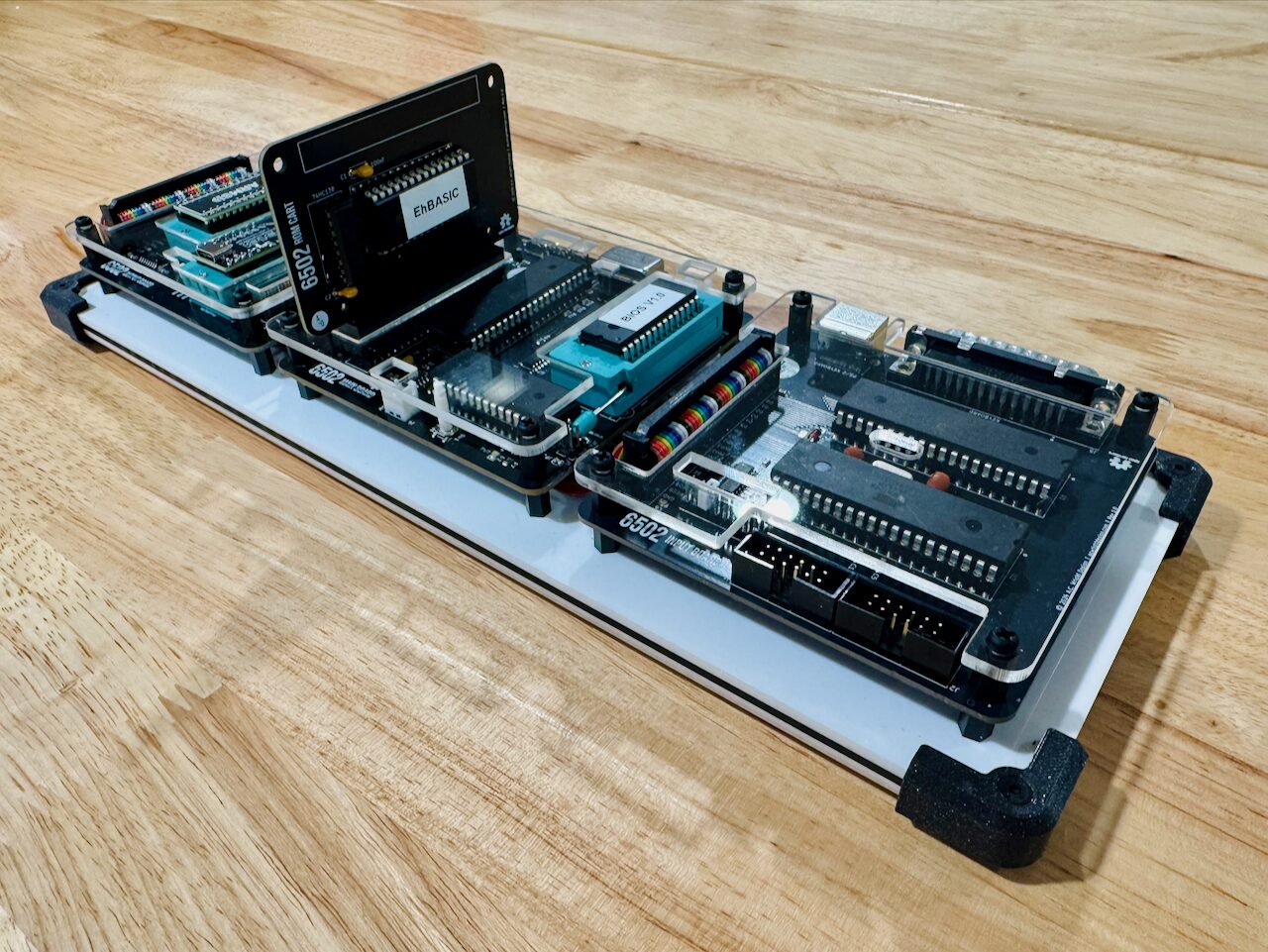
The VCS is where the family first stopped being a stack of cards. Three boards instead of nine:
- Main Board — 65C02, 32 KB of RAM, 32 KB of ROM, clock and reset. Powered over USB-C. It carries the bus for the other two.
- Input Board — matrix keyboard, PS/2 keyboard and both joysticks, through a 65C22 VIA with an ATmega1284P doing the scanning.
- Output Board — VGA video and SID audio.
That consolidation is the direct ancestor of the ACE, which does the same job with one board instead of three.
Cartridges
Programs arrive on ROM Carts — a small board with an EEPROM on it that overlays the top of the memory map and takes over at reset. The slot is a card edge on the board itself, facing up, so a cartridge stands vertically in it rather than sliding in from the front. There's no CompactFlash slot and no serial port on a VCS: the cartridge is the storage.
Two cartridge revisions exist, differing in which memory parts they accept. 6502-CRT is the template project for writing one.
The ACE takes the same cartridges
The ACE has a cartridge slot too, so anything built for the VCS runs there — and the same slot is what the KIM keypad plugs into.
Joysticks
The VCS reads its two sticks through the same VIA ports as the keyboard encoder, rather than giving them connectors of their own — they come in on the J1 and J2 port headers. J1 reads as JOY(1) and J2 as JOY(2).
Where to get it
6502-VCS repository — three boards, the cartridge, the input firmware and the bills of materials. The printable reference sheet is here.
The Main Board is also one of the two ways to build a standalone KIM.
📄 6502-VCS card — the machine on two printable pages. The card index has the rest.